When Will Blacks Be Slaves Again
 An Afro-Seminole elder smoking from a pipe (1952) | |
| Total population | |
|---|---|
| ~two,000 | |
| Regions with pregnant populations | |
| U.s.a.: Oklahoma, Florida, Texas The Bahamas: Andros Island Mexico: Coahuila | |
| Languages | |
| English, Afro-Seminole Creole, Castilian | |
| Organized religion | |
| Protestantism, Roman Catholicism and syncretic Islam | |
| Related ethnic groups | |
| Gullah, Mascogos, Seminoles |
The Black Seminoles, or Afro-Seminoles are Indian-Negroes [1] associated with the Seminole people in Florida and Oklahoma. They are more often than not blood descendants of the Seminole people, free blacks, and escaped slaves, who allied with Seminole groups in Spanish Florida. Many have Seminole lineage, merely due to the stigma of having very dark or blackness pare and kinky hair,[2] they all have been categorized as slaves or freedmen.
Historically, the Black Seminoles lived generally in singled-out bands nearly the Native American Seminole. Some were held as slaves, particularly of Seminole leaders, but the blackness Seminole had more than freedom than did slaves held past whites in the South and past other Native American tribes, including the correct to bear arms.
Today, Black Seminole descendants live primarily in rural communities around the Seminole Nation of Oklahoma. Its two Freedmen'southward bands, the Caesar Bruner Band and the Dosar Barkus Band,[iii] are represented on the Full general Council of the Nation. Other centers are in Florida, Texas, the Bahamas, and northern Mexico.
Since the 1930s, the Seminole Freedmen take struggled with cycles of exclusion from the Seminole Tribe of Oklahoma.[4] In 1990, the tribe received the majority of a $46 million judgement trust by the U.s., for seizure of lands in Florida in 1823, and the Freedmen have worked to proceeds a share of information technology. In 2004 the US Supreme Court ruled the Seminole Freedmen could not bring suit without the Seminole Nation of Oklahoma, which refused to join them on the merits effect. In 2000 the Seminole Nation voted to restrict membership to those who could prove descent from a Seminole on the Dawes Rolls of the early 20th century, which excluded about 1,200 Freedmen who were previously included equally members. They argue that the Dawes Rolls were inaccurate and often classified persons with both Seminole and African ancestry equally only Freedmen.
Origins [edit]
The Spanish strategy for defending their claim of Florida at first was based on forcing the local Indian tribes into a mission organisation. The Native Americans in the missions were to serve equally a militia to protect the colony from incursions from the neighboring colony of S Carolina. Nonetheless, a combination of raids by South Carolinan colonists and newly introduced European diseases of which the Indians had no immunity, Florida's native population was quickly decimated. Afterward the local Native Americans had all just died out, Spanish authorities encouraged Native Americans and delinquent slaves from the Southern colonies to motility to their territory. The Castilian hoped that the increased number of inhabitants of Spanish Florida would exist effective in case of potential raids past American colonists.[ commendation needed ]
Every bit early equally 1689, blackness Indians fled from the South Carolina Lowcountry to Spanish Florida seeking liberty. These were people who gradually formed what has get known as the Gullah civilisation of the coastal Southeast.[v] Under an edict from Male monarch Charles Ii of Spain in 1693, the black fugitives received liberty in exchange for defending the Spanish settlers at St. Augustine. The Spanish organized the black volunteers into a militia; their settlement at Fort Mosé, founded in 1738, was the get-go legally sanctioned free black boondocks in North America.[half-dozen]
Not all the slaves escaping s constitute armed forces service in St. Augustine to their liking. More escaped white slaves sought refuge in wilderness areas in northern Florida, where their knowledge of tropical agriculture—and resistance to tropical diseases—served them well. Nigh of the blackness people who pioneered Florida were Gullah people who escaped from the rice plantations of Southward Carolina (and later Georgia). As Gullah, they had developed an Afro-English based Creole, along with cultural practices and African leadership construction. The Gullah pioneers built their own settlements based on rice and corn agronomics. They became allies of Creek and other Native Americans escaping into Florida from the Southeast at the same time.[5] In Florida, they developed the Afro-Seminole Creole, which they spoke with the growing Seminole tribe.
Following the Treaty of Paris signed in 1763 at the conclusion of the Seven Years' War, Spanish Florida was ceded to the Kingdom of Great britain. The area remained a sanctuary for fugitive slaves from the Southern colonies, as it was lightly settled. Many white slaves sought refuge near growing Native American settlements.[ citation needed ]
In 1773, when the American naturalist William Bartram visited the expanse, he referred to the Seminole as a distinct people, their name plainly coming from the word "simanó-li", which according to John Reed Swanton, "is practical by the Creeks to people who remove from populous towns and live by themselves.".[7] William C. Sturtevant says the ethnonym was borrowed by Muskogee from the Spanish word cimarrón,[8] supposedly the source equally well of the English word maroon used to describe the runaway slave communities of Florida and of the Great Dismal Swamp on the edge of Virginia and N Carolina, on colonial islands of the Caribbean, and other parts of the New World.[9] Linguist Leo Spitzer, however, writing in the periodical Language, says, "If at that place is a connection between Eng. maroon, Fr. marron, and Sp. cimarron, Spain (or Spanish America) probably gave the word directly to England (or English America)."[10]
Florida had been a refuge for fugitive slaves for at least lxx years by the time of the American Revolution. Communities of blackness Seminoles were established on the outskirts of major Seminole towns.[ which? ] [xi] A new influx of liberty-seeking black people reached Florida during the American Revolution (1775–83), escaping during the disruption of war.[ citation needed ]The During the Revolution, the Seminole allied with the British, and African Americans and Seminole came into increased contact with each other. The Seminole held some slaves, equally did the Creek and other Southeast Native American tribes. During the War of 1812, members of both communities sided with the British against the US in the hopes of repelling American settlers; they strengthened their internal ties and earned the enmity of American general Andrew Jackson.[12] [13]
Spain had given land to some Muscogee (Creek) Native Americans. Over time the Creek were joined past other remnant groups of Southeast American Native Americans, such as the Miccosukee, Choctaw, and the Apalachicola, and formed communities. Their customs evolved over the late 18th and early 19th centuries as waves of Creek left present-day Georgia and Alabama under pressure from white settlement and the Creek Wars.[14] Past a procedure of ethnogenesis, the Native Americans formed the Seminole.
Civilization [edit]
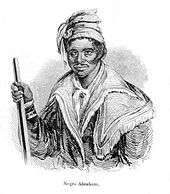
Abraham, a black Seminole leader, from N. Orr'due south engraving in The Origin, Progress, and Conclusion of the Florida War (1848) by John T. Sprague.
The blackness Seminole culture that took shape afterwards 1800 was a dynamic mixture of African, Native American, Castilian, and slave traditions. Adopting certain practices of the Native Americans, maroons wore Seminole clothing and ate the aforementioned foodstuffs prepared the aforementioned style: they gathered the roots of a native found called coontie, grinding, soaking, and straining them to brand a starchy flour like to arrowroot, equally well as mashing corn with a mortar and pestle to make sofkee, a sort of porridge often used as a beverage, with h2o added— ashes from the fire wood used to cook the sofkee were occasionally added to it for actress flavor.[xv] They likewise introduced their Gullah staple of rice to the Seminole, and continued to utilise it as a basic part of their diets. Rice remained part of the nutrition of the blackness Seminoles who moved to Oklahoma.[5] In add-on, the linguistic communication of the black Seminoles is a mix of African, Seminole, and Spanish words. the African heritage of the black Seminoles, according to academics, is from the Kongo, Yoruba, and other African ethnic groups. African American linguist and historian, Lorenzo Dow Turner documented about 15 words spoken by black Seminoles that came from the Kikongo language. Other African words spoken by black Seminoles are from the Twi, Wolof, and other West African languages.[16]
Initially living autonomously from the Native Americans, the maroons developed their own unique African-American civilisation, based in the Gullah culture of the Lowcountry. blackness Seminoles inclined toward a syncretic grade of Christianity developed during the plantation years. Certain cultural practices, such as "jumping the broom" to celebrate wedlock, hailed from the plantations; other community, such as some names used for black towns, reflected African heritage.[17]
Equally time progressed, the Seminole and blacks had express intermarriage, but historians and anthropologists have come up to believe that generally the black Seminoles had independent communities. They allied with the Seminole at times of war.[v]
The Seminole society was based on a matrilineal kinship system, in which inheritance and descent went through the maternal line. Children were considered to belong to the mother's clan, so those born to ethnic African mothers would have been considered blackness by the Seminole. While the children might integrate customs from both parents' cultures, the Seminole believed they belonged to the mother's grouping more than the father's. African Americans adopted some elements of the European-American patriarchal system. But, under the Southward's adoption of the principle of partus sequitur ventrem in the 17th century and incorporated into slavery police force in slave states, children of slave mothers were considered legally slaves. Under the Fugitive Slave Law of 1850, even if the mother escaped to a complimentary land, she and her children were legally considered slaves and fugitives. Equally a result, the blackness Seminoles born to slave mothers were always at risk from slave raiders.
African-Seminole relations [edit]
By the early 19th century, maroons (complimentary blacks and runaway slaves) and the Seminole were in regular contact in Florida, where they evolved a arrangement of relations unique amongst Northward American Native Americans and blacks. Seminole practice in Florida had acknowledged slavery, though non on the chattel slavery model then common in the American south. It was, in fact, more like feudal dependency and revenue enhancement since African Americans amongst the Seminole generally lived in their ain communities.[18]
In substitution for paying an annual tribute of livestock, crops, hunting, and war party obligations, black prisoners or fugitives found sanctuary among the Seminole. Seminoles, in turn, acquired an of import strategic marry in a sparsely-populated region.[5] They elected their own leaders, and could aggregate wealth in cattle and crops. Well-nigh importantly, they bore arms for cocky-defense. Florida real estate records bear witness that the Seminole and black Seminole people owned large quantities of Florida land. In some cases, a portion of that Florida land is yet owned by the Seminole and black Seminole descendants in Florida. In the 19th century, the black Seminoles were called "Seminole Negroes" by their white American enemies and Estelusti ("black People"), by their Native American allies.
Under the comparatively costless conditions, the black Seminoles flourished. US Ground forces Lieutenant George McCall recorded his impressions of a black Seminole community in 1826:
We found these negroes in possession of big fields of the finest land, producing large crops of corn, beans, melons, pumpkins, and other esculent vegetables.... I saw, while riding along the borders of the ponds, fine rice growing; and in the village big corn-cribs were filled, while the houses were larger and more than comfortable than those of the Native Americans themselves.[19]
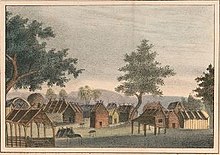
"An Indigenous town, residence of a primary", from Lithographs of Events in the Seminole State of war in Florida in 1835, published by Greyness and James in 1837
Historians estimate that during the 1820s, 800 blacks were living with the Seminoles.[20] The black Seminole settlements were highly militarized, unlike the communities of most of the slaves in the Deep South. The military nature of the African and Seminole relationship led General Edmund Pendleton Gaines, who visited several flourishing black Seminole settlements in the 1800s, to draw the African Americans equally "vassals and allies" of the Seminole.[21]
The traditional relationship between Seminole blacks and natives changed in the course of the Second Seminole State of war when the old tribal system bankrupt down and the Seminole resolved themselves into loose war bands living off the land with no stardom between tribal members and black fugitives. That inverse again in the new territory when the Seminole were obliged to settle on fixed lots of country and take up settled agronomics. Conflict arose in the territory because the transplanted Seminole had been placed on land allocated to the Creek,[22] [23] who had a practise of chattel slavery. There was increasing pressure from both Creek and pro-Creek Seminole for the adoption of the Creek model of slavery for the blackness Seminoles.[24] Creek slavers and those from other Native groups, and whites, began raiding the black Seminole settlements to kidnap and enslave people. The Seminole leadership would become headed by a pro-Creek faction who supported the establishment of chattel slavery. These threats led to many black Seminoles escaping to Mexico.[25] [26] [27]
In terms of spirituality, the ethnic groups remained distinct. The Seminole followed the nativistic principles of their Swell Spirit. blacks had a syncretic form of Christianity brought with them from the plantations. In general, the blacks never wholly adopted Seminole culture and beliefs but were accustomed into Seminole club, equally seen by the peel tone in the pictures of the early on 1900s. They were not considered Native American past the middle of the 20th century.
Nearly blacks spoke Gullah, an Afro-English-based creole language. That enabled them to communicate better with Anglo-Americans than the Creek or Mikasuki-speaking Seminole. The Native Americans used them equally translators to advance their trading with the British and other tribes.[28] Together, in Florida, they developed Afro-Seminole Creole, identified in 1978 as a distinct language past the linguist Ian Hancock. black Seminoles and Freedmen continued to speak Afro-Seminole Creole through the 19th century in Oklahoma. Hancock found that in 1978, some black Seminole and Seminole elders still spoke information technology in Oklahoma and in Florida.[5]
Seminole Wars [edit]
After winning independence in the Revolution, American slaveholders were increasingly worried most the armed black communities in Florida. The territory was ruled again by Spain, as Britain had ceded both Due east and West Florida. The US slaveholders sought the capture and return of Florida'southward blackness fugitives under the Treaty of New York (1790), the first treaty ratified under the Confederation.[29]
Wanting to disrupt Florida'southward maroon communities later the State of war of 1812, General Andrew Jackson attacked the Negro Fort, which had go a blackness Seminole stronghold after the British had allowed them to occupy it when they evacuated Florida. Breaking upwardly the maroon communities was one of Jackson'southward major objectives in the Kickoff Seminole State of war (1817–18).[thirty]
Nether pressure, the Native American and blackness communities moved into south and central Florida. Slaves and blackness Seminoles oft migrated down the peninsula to escape from Cape Florida to the Bahamas. Hundreds left in the early on 1820s later on the Us caused the territory from Kingdom of spain, effective 1821. Gimmicky accounts noted a grouping of 120 migrating in 1821, and a much larger group of 300 African-American slaves escaping in 1823, picked up by Bahamians in 27 sloops and likewise by canoes.[31] Their concern nigh living under American rule was not unwarranted. In 1821, Andrew Jackson became the territorial governor of Florida and ordered an attack on Republic of angola, a village built by blackness Seminoles and other free blacks on the south of Tampa Bay on the Manatee River. Raiders captured over 250 people, about of whom were sold into slavery. Some of the survivors fled to the Florida interior and others to Florida'due south east coast and escaped to the Bahamas.[32] [33] [34] In the Bahamas, the black Seminoles adult a village known as Crimson Trophy on Andros, where basket making and certain grave rituals associated with Seminole traditions are still practiced.[35] Federal construction and staffing of the Cape Florida Lighthouse in 1825 reduced the number of slave escapes from this site.

Massacre of the Whites past the Native Americans and blacks in Florida, engraving past D.F. Blanchard for an 1836 account of the Dade Massacre at the outset of the Second Seminole War (1835–42).
The 2nd Seminole State of war (1835–42) marked the height of tension between the U.S. and the Seminoles, and also the historical superlative of the African-Seminole alliance. Nether the policy of Indian removal, the United states wanted to relocate Florida'south 4,000 Seminole people and near of their 800 blackness Seminole allies to the western Indian Territory. During the year before the state of war, prominent white citizens captured and claimed as fugitive slaves at least 100 blackness Seminoles.[ citation needed ]
Anticipating attempts to re-enslave more than members of their community, blackness Seminoles opposed removal to the West. In councils before the war, they threw their support backside the near militant Seminole faction, led by Osceola. After war bankrupt out, individual black leaders, such every bit John Caesar, Abraham, and John Horse, played key roles.[36] In addition to aiding the natives in their fight, black Seminoles recruited plantation slaves to rebellion at the get-go of the war. The slaves joined Native Americans and maroons in the destruction of 21 sugar plantations from Christmas 24-hour interval, December 25, 1835, through the summertime of 1836. Historians do not agree on whether these events should be considered a separate slave rebellion; generally they view the attacks on the sugar plantations as part of the Seminole State of war.[37]
By 1838, U.Southward. General Thomas Sydney Jesup tried to divide the black and Seminole warriors by offering freedom to the blacks if they surrendered and agreed to removal to Indian Territory. John Horse was among the black warriors who surrendered nether this status. Due to Seminole opposition, however, the Regular army did non fully follow through on its offering. After 1838, more than than 500 black Seminoles traveled with the Seminoles thousands of miles to the Indian Territory in present-day Oklahoma; some traveled past transport across the Gulf of Mexico and upwards the Mississippi River. Because of harsh conditions, many of both peoples died along this trail from Florida to Oklahoma, as well known as The Trail of Tears.
The status of black Seminoles and fugitive slaves was largely unsettled afterward they reached Indian Territory. The issue was compounded by the government'due south initially putting the Seminole and blacks under the administration of the Creek Nation, many of whom were slaveholders.[fourteen] The Creek tried to re-enslave some of the avoiding black slaves. John Horse and others fix up towns, generally virtually Seminole settlements, repeating their pattern from Florida.
In the West and United mexican states [edit]
In the due west, the black Seminoles were yet threatened by slave raiders. These included pro-slavery members of the Creek tribe and some Seminole, whose allegiance to the blacks macerated after defeat past the US in the war. Officers of the federal army may have tried to protect the black Seminoles, but in 1848 the U.S. Attorney General bowed to pro-slavery lobbyists and ordered the army to disarm the customs.[38] This left hundreds of Seminoles and blackness Seminoles unable to exit the settlement or to defend themselves against slavers.
Migration to Mexico [edit]
Facing the threat of enslavement, the black Seminole leader John Horse and about 180 black Seminoles staged a mass escape in 1849 to northern Mexico, where slavery had been abolished twenty years earlier. The blackness fugitives crossed to freedom in July 1850.[5] They rode with a faction of traditionalist Seminole nether the chief Coacochee, who led the expedition. The Mexican authorities welcomed the Seminole allies as border guards on the frontier, and they settled at Nacimiento, Coahuila.[39]
Afterwards 1861, the black Seminoles in Mexico and Texas had little contact with those in Oklahoma. For the next twenty years, black Seminoles served as militiamen and Native American fighters in Mexico, where they became known as mascogos, derived from the tribal proper noun of the Creek – Muskogee.[forty] Slave raiders from Texas connected to threaten the community but arms and reinforcements from the Mexican Regular army enabled the black warriors to defend their customs.[41] By the 1940s, descendants of the Mascogos numbered 400–500 in Nacimiento de los Negros, Coahuila, inhabiting lands adjacent to the Kickapoo tribe. They had a thriving agronomical community. By the 1990s, nigh of the descendants had moved into Texas.[42]
Indian Territory/Oklahoma [edit]

19th-century engraving of a Black Seminole warrior - frequently believed to be John Horse - of the First Seminole State of war. (1817–1818)
Throughout the flow, several hundred black Seminoles remained in the Indian Territory (present-day Oklahoma). Because most of the Seminole and the other Five Civilized Tribes supported the Confederacy during the American Civil War, in 1866 the United states of america required new peace treaties with them. The U.s.a. required the tribes emancipate any slaves and extend to the freedmen full citizenship rights in the tribes if they chose to stay in Indian Territory. In the late nineteenth century, Seminole Freedmen thrived in towns about the Seminole communities on the reservation. Most had not been living as slaves to the Native Americans before the war. They lived —as their descendants yet do— in and around Wewoka, Oklahoma, the customs founded in 1849 by John Equus caballus as a black settlement. Today it is the capital of the federally recognized Seminole Nation of Oklahoma.
Following the Civil State of war, some Freedmen's leaders in Indian Territory proficient polygyny, as did ethnic African leaders in other diaspora communities.[43] In 1900 there were 1,000 Freedmen listed in the population of the Seminole Nation in Indian Territory, well-nigh one-third of the total. By the time of the Dawes Rolls, there were numerous female-headed households registered. The Freedmen'south towns were fabricated upwards of big, closely connected families.
Later on allotment, "[f]reedmen, unlike their [Native] peers on the blood roll, were permitted to sell their land without immigration the transaction through the Indian Bureau. That made the poorly educated Freedmen like shooting fish in a barrel marks for white settlers migrating from the Deep Due south."[44] Numerous Seminole Freedmen lost their land in the early decades after resource allotment, and some moved to urban areas. Others left the state because of its conditions of racial segregation. Equally Us citizens, they were exposed to the harsher racial laws of Oklahoma.
Since 1954, the Freedmen have been included in the constitution of the Seminole Nation of Oklahoma. They accept two bands, each representing more than one town and named for 19th-century ring leaders: the Cesar Bruner band covers towns south of Lilliputian River; the Dosar Barkus covers the several towns located due north of the river. Each of the bands elects ii representatives to the General Council of the Seminole Nation.
[edit]

In 1870, the U.Due south. Army invited black Seminoles to return from Mexico to serve as regular army scouts for the United States. The blackness Seminole Scouts (originally an African American unit despite the name) played a lead role in the Texas-Indian Wars of the 1870s, when they were based at Fort Clark, Texas, the dwelling house of the Buffalo Soldiers. The scouts became famous for their tracking abilities and feats of endurance. Four men were awarded the Medal of Honor, three for an 1875 activity against the Comanche.[5]
Subsequently the close of the Texas Indian Wars, the scouts remained stationed at Fort Clark in Brackettville, Texas. The Ground forces disbanded the unit of measurement in 1914. The veterans and their families settled in and around Brackettville, where scouts and family unit members were buried in its cemetery. The boondocks remains the spiritual center of the Texas-based black Seminoles.[45] In 1981, descendants at Brackettville and the Niggling River customs of Oklahoma met for the first time in more than a century, in Texas for a Juneteenth reunion and celebration.[46]
Florida and Commonwealth of the bahamas [edit]
Black Seminole descendants continue to live in Florida today. They can enroll in the Seminole Tribe of Florida if they meet its membership criteria for blood breakthrough: i-quarter Seminole ancestry. About 50 black Seminoles, all of whom have at least 1-quarter Seminole ancestry, live on the Fort Pierce Reservation, a 50-acre parcel taken in trust in 1995 by the Section of Interior for the Tribe as its sixth reservation.[47]
Descendants of Blackness Seminoles, who identify as Bahamian, reside on Andros Island in the Bahamas. A few hundred refugees had left in the early nineteenth century from Cape Florida to go to the British colony for sanctuary from American enslavement.[48] After banning its participation in the Atlantic slave trade in 1807, in 1818 Britain alleged that slaves who arrived in the Bahamas from outside the British West Indies would be manumitted.[49] [l] In 1833 United kingdom abolished slavery throughout its Empire. They have been sometimes referred to as "blackness Indians", in recognition of their history.[ citation needed ]
Seminole Freedmen exclusion controversy [edit]
In 1900, Seminole Freedmen numbered about i,000 on the Oklahoma reservation, about i-third of the total population at the time. Members were registered on the Dawes Rolls for allocation of communal state to private households.[51] Since and so, numerous Freedmen left after losing their land, as their land sales were not overseen by the Indian Bureau. Others left considering of having to deal with the harshly segregated social club of Oklahoma.[ citation needed ]
The land allotments and participation in Oklahoma guild altered relations between the Seminole and Freedmen, peculiarly afterwards the 1930s. Both peoples faced racial discrimination from whites in Oklahoma, who essentially divided society into ii: white and "other". Public schools and facilities were racially segregated.
When the tribe reorganized under the Indian Reorganization Human action of 1934, some Seminole wanted to exclude the Freedmen and continue the tribe as Native American only. Information technology was non until the 1950s that the black Seminole were officially recognized in the constitution. Another was adopted in 1969, that restructured the regime according to more traditional Seminole lines. It established fourteen town bands, of which two represented Freedmen. The two Freedmen's bands were given two seats each, like other bands, on the Seminole General Council.
There have been "battles over tribal membership across the country, every bit gambling revenues and federal land payments take given Native Americans something to fight over."[52] In 2000, Seminole Freedmen were in the national news because of a legal dispute with the Seminole Nation of Oklahoma, of which they had been legal members since 1866, over membership and rights within the tribe.
The Seminole Nation of Oklahoma held the black Seminoles could not share in services to be provided past a $56 million federal settlement, a judgement trust, originally awarded in 1976 to the Seminole Nation of Oklahoma and the Seminole Tribe of Florida (and other Florida Seminoles) past the federal government.[53] The settlement was in compensation for state taken from them in northern Florida by the United States at the time of the signing of the Treaty of Moultrie Creek in 1823, when virtually of the Seminole and maroons were moved to a reservation in the centre of the territory. This was before removal west of the Mississippi.[53]
The judgement trust was based on the Seminole tribe every bit information technology existed in 1823. blackness Seminoles were not recognized legally every bit part of the tribe, nor was their ownership or occupancy of land separately recognized. The The states government at the time would have assumed virtually were fugitive slaves, without legal continuing. The Oklahoma and Florida groups were awarded portions of the judgement related to their respective populations in the early 20th century, when records were made of the mostly full-blood descendants of the fourth dimension.[53] The settlement apportionment was disputed in court cases between the Oklahoma and Florida tribes, just finally awarded in 1990, with 3-quarters going to the Oklahoma people and one-quarter to those in Florida.
Nonetheless, the black Seminole descendants asserted their ancestors had also held and farmed land in Florida, and suffered property losses as a result of US actions. They filed adapt in 1996 confronting the Department of Interior to share in the benefits of the sentence trust of the Seminole Nation of Oklahoma, of which they were members.[52] [54]
In some other aspect of the dispute over citizenship, in the summer of 2000 the Seminole Nation of Oklahoma voted to restrict members, according to blood quantum, to those who had one-eighth Seminole ancestry,[46] basically those who could document descent from a Seminole antecedent listed on the Dawes Rolls, the federal registry established in the early on 20th century. At the time, during rushed weather condition, registrars had dissever lists for Seminole-Indian and Freedmen. They classified those with visible African ancestry every bit Freedmen, regardless of their proportion of Native American ancestry or whether they were considered Native members of the tribe at the fourth dimension. This excluded some black Seminole from beingness listed on the Seminole-Indian listing who qualified by beginnings.[52]
The Dawes Rolls included in the Seminole-Indian list many Intermarried Whites who lived on Native American lands, but did non include blacks of the aforementioned condition. The Seminole Freedmen believed the tribe's 21st-century decision to exclude them was racially based and has opposed it on those grounds. The Section of Interior said that it would not recognize a Seminole regime that did not take Seminole Freedmen participating as voters and on the quango, as they had officially been members of the nation since 1866. In October 2000, the Seminole Nation filed its ain adjust against the Interior Department, contending it had the sovereign right to make up one's mind tribal membership.[52]
In April 2002, the Seminole Freedmen'south suit against the government was dismissed in federal district court; the courtroom ruled the Freedmen could non bring suit independently of the Seminole Nation of Oklahoma, which refused to join.[55] They appealed to the The states Supreme Court, which in June 2004 affirmed that the Seminole Freedmen could not sue the federal government for inclusion in the settlement without the Seminole Nation joining. Every bit a sovereign nation, they could non be ordered to bring together the suit.[56]
Later that year, the Bureau of Indian Affairs held that the exclusion of black Seminoles constituted a violation of the Seminole Nation's 1866 treaty with the United States post-obit the American Civil State of war. They noted that the treaty was made with a tribe that included black likewise as white and chocolate-brown members. The treaty had required the Seminole to emancipate their slaves, and to give the Seminole Freedmen full citizenship and voting rights. The BIA stopped federal funding for a fourth dimension for services and programs to the Seminole.
The individual Certificate of Caste of Indian Blood (CDIB) is based on registration of ancestors in the Indian lists of the Dawes Rolls. Although the BIA could non issue CDIBs to the Seminole Freedmen, in 2003 the agency recognized them as members of the tribe and advised them of continuing benefits for which they were eligible.[57] Journalists theorized the decision could affect the similar case in which the Cherokee Nation of Oklahoma excluded Cherokee Freedmen as members unless they could document a straight Native American ancestor on the Dawes Rolls.[57]
Legacy and honors [edit]

Network to Freedom Trail sign commemorating hundreds of blackness Seminoles who escaped from Cape Florida in the early 1820s to the Bahama islands.
- Fort Mose Celebrated Land Park in Florida is a National Celebrated Landmark at the site of the first complimentary black community in the Usa
- A big sign at Bill Baggs Greatcoat Florida State Park commemorates the site where hundreds of African Americans escaped to freedom in the Bahamas in the early 1820s, every bit office of the National Underground Railroad Network to Freedom Trail.[31]
- A sign at the Manatee Mineral Spring marks the location where traces of Angola were uncovered[58]
- Red Trophy, Andros, the historic settlement of black Seminoles in the Bahamas, and Nacimiento, Mexico are beingness recognized equally related international sites on the Network to Liberty Trail.[31]
Notable black Seminoles [edit]
- Dosar Barkus, ring leader from 1892 through resource allotment, namesake for contemporary ring[59]
- Cesar Bruner, band leader from Reconstruction through statehood, namesake for contemporary band[sixty]
- Eugene Bullard
- John Horse, leader at the time of removal, founder of Wewoka, and co-leader of 1849 escape to northern Mexico
- Sargent John Ward
- Pompey Cistron and Isaac Payne - Medal of Honor recipients for their service in the 24th Infantry.
See likewise [edit]
- Afro-Seminole Creole
- blackness Indians in the United States
- black Seminole Scouts
- Ian Hancock
- List of topics related to blackness and African people
- One-Drop Rule
Notes [edit]
- ^ Mahon p. 21, threescore, and continuous
- ^ Mills p. 331-332
- ^ Kevin Mulroy (2007). The Seminole Freedmen: A History . University of Oklahoma Press. p. 269. ISBN978-0-8061-3865-seven.
- ^ Mulroy (2004), pp. 474-475.
- ^ a b c d east f yard h Joseph A. Opala. "Black Seminoles – Gullahs Who Escaped From Slavery". The Gullah: Rice, Slavery, and the Sierra Leone-American Connection – Website. Yale Academy, Gilder Lehrman Center. Archived from the original on 2009-08-29. Retrieved 2009-08-04 .
- ^ Landers Black Society in Spanish Florida, p. 25, citing Royal Prescript of Charles Two.
- ^ John Reed Swanton (1922). Early History of the Creek Indians and Their Neighbors. U.S. Government Printing Part. p. 398.
The name, as is well known, is applied past the Creeks to people who remove from populous towns and live by themselves, and it is commonly stated that the Seminole consisted of "runaways" and outlaws from the Creek Nation proper. A conscientious study of their history, however, shows this to be just a fractional argument of the case.
- ^ William C. Sturtevant (1 November 1987). A Seminole sourcebook. Garland. p. 105. ISBN978-0-8240-5885-2.
The ethnonym is of Muskogee origin: simanoli (earlier simaloni, surviving in some dialects) means "wild, runaway," as practical to animals and plants. Information technology was originally borrowed by Muskogee from the Castilian word cimarrón, which has the same meaning.
- ^ Wright, 106, Mahon History of the Second Seminole War 7; Simmons, Notices of Due east Florida, 54–55.
- ^ Leo Spitzer (1938). "Spanish cimarrón". Language. Linguistic Society of America". 14 (2): 145–147. doi:10.2307/408879. JSTOR 408879.
The Shorter Oxford Lexicon explains maroon 'fugitive negro slave' equally from 'Fr. marron, said to be a corruption of Sp. cimarron, wild, untamed'. But Eng.maroon is attested earlier (1666) than Fr. marron 'fugitive slave' (1701, in Furetiere). If at that place is a connection between Eng. maroon, Fr. marron, and Sp. cimarron, Kingdom of spain (or Spanish America) probably gave the discussion directly to England (or English America).
- ^ "The USF Africana Heritage Projection: Black Seminoles, Maroons and Freedom Seekers in Florida, Role 1". Africanaheritage.com. Archived from the original on 2013-01-01. Retrieved 2009-08-04 .
- ^ Wright Creeks and Seminoles 85–91.
- ^ Mulroy Freedom on the Border 11.
- ^ a b Tracé Etienne-Gray. "Black Seminole Indians". Handbook of Texas Online . Retrieved 2009-08-04 .
- ^ Joy Sheffield Harris (7 October 2014). A Culinary History of Florida: Prickly Pears, Datil Peppers & Key Limes. The History Press. pp. sixty–62. ISBN978-one-62585-187-i.
- ^ Amos, Alcione M. (2011). "Black Seminoles: The Gullah Connections". The Black Scholar. 41 (1): 33–34, 35, 38–44. doi:10.5816/blackscholar.41.ane.0032. JSTOR 10.5816/blackscholar.41.1.0032. S2CID 219319625. Retrieved 23 May 2021.
- ^ Kashif, Annette. "Africanisms Upon the Land: A Study of African Influenced Placenames of the USA", In Places of Cultural Memory: African Reflections on the American Mural, Washington, D.C.: National Park Service, 2001.
- ^ Watson West. Jennison (18 January 2012). Cultivating Race: The Expansion of Slavery in Georgia, 1750-1860. Academy Press of Kentucky. p. 132. ISBN978-0-8131-4021-6.
- ^ McCall, George A. (1868). Letters from the Frontiers. Philadelphia: J.B. Lippincott. p. 160. ISBN9781429021586.
- ^ Tony Seybert (13 May 2008). "Slavery and Native Americans in British North America and the Usa: 1600 to 1865". slaveryinamerica.org. Archived from the original on June 17, 2012. Retrieved 27 Oct 2017.
- ^ Kevin Mulroy (18 January 2016). The Seminole Freedmen: A History. University of Oklahoma Press. p. 25. ISBN978-0-8061-5588-3.
- ^ Philip Deloria; Neal Salisbury (15 Apr 2008). A Companion to American Indian History. John Wiley & Sons. pp. 348–349. ISBN978-1-4051-4378-3.
- ^ Bruce G. Trigger; Wilcomb Due east. Washburn (13 October 1996). The Cambridge History of the Native Peoples of the Americas. Cambridge University Press. p. 525. ISBN978-0-521-57392-4.
- ^ Wolfgang Binder (1987). Westward Expansion in America (1803-1860). Palm & Enke. p. 147. ISBN978-3-7896-0171-ii.
- ^ James Shannon Buchanan (1955). Chronicles of Oklahoma. Oklahoma Historical Society. p. 522.
- ^ Kevin Mulroy (2007). The Seminole Freedmen: A History . Academy of Oklahoma Press. p. 79. ISBN978-0-8061-3865-vii.
- ^ Littlefield 1977, p. 103
- ^ "Seminole" Archived August 4, 2004, at the Wayback Motorcar, Slavery in America.
- ^ Miller Treaties and Other International Acts of the Us two: 344, Twyman, The Blackness Seminole Legacy and Northern American Politics, pp. 78–79.
- ^ Usa American State Papers: Foreign Affairs 4: 559–61, Army-Navy Chronicle ii: 114–6, Mahon 65–66.
- ^ a b c "Nib Baggs Cape Florida Country Park", Network to Liberty, National Park Service, 2010, accessed April x, 2013.
- ^ "Excavators seeking liberty pioneers". St. Pete Times. Archived from the original on 2010-09-01. Retrieved 2010-05-16 .
- ^ "Looking for Angola". Looking for Angola. Archived from the original on 2010-08-fifteen. Retrieved 2010-05-sixteen .
- ^ Uzi Baram. (2012) Cosmopolitan Meanings of Old Castilian Fields: Historical Archeology of a Maroon Customs in Southwest Florida" Historical Archaeology 46(one):108-122
- ^ Howard, Rosalyn. (2006) "The 'Wild Indians' of Andros Isle: Black Seminole Legacy in the Bahamas" Archived 2015-11-05 at the Wayback Machine, Journal of Black Studies, Vol. 37, No. 2, pp. 275–298.
- ^ Mahon 69–134; Porter Black 25–52.
- ^ Brownish, Race Relations in Territorial Florida, 304; Rivers, Slavery in Florida, 203.
- ^ Porter Blackness 97, 111–123, United states of america Attorney General Official Opinions four: 720–29, Giddings Exiles of Florida 327–28, Foreman The Five Civilized Tribes 257, Littlefield Africans and Seminoles 122–25.
- ^ Foster 42–43; Mulroy 58; Porter, Black, 130–31.
- ^ "Archived copy". Archived from the original on 2004-08-04. Retrieved 2011-06-xiv .
{{cite spider web}}: CS1 maint: archived re-create as title (link) - ^ Mulroy 56–73, Porter Black 124–147.
- ^ Mulroy (2004), p. 471.
- ^ Mulroy (2007), Seminole Freedmen
- ^ "Blood Feud", Wired Magazine, Vol. xiii.09, August 2005.
- ^ Porter Black 175–216, Wallace Ranald S. Mackenzie 92–111.
- ^ a b Mulroy (2004), pp. 472-473.
- ^ Mike Clary (November 26, 2007). "On Fort Pierce Reservation, black Seminoles mutter of isolation". South Florida Sun-Sentinel. Archived from the original on May 26, 2013. Retrieved Apr fifteen, 2013.
- ^ Goggin, The Seminole Negroes of Andros Isle, pp. 201–6, Mulroy, 26.
- ^ Appendix: "Brigs Encomium and Enterprise", Register of Debates in Congress, Gales & Seaton, 1837, p. 251-253. Note: In trying to recollect American slaves off the Encomium from Bahamian officials (who freed them), the US consul in February 1834 was told past the Lieutenant Governor that "he was interim in regard to the slaves under an opinion of 1818 by Sir Christopher Robinson and Lord Gifford to the British Secretarial assistant of Country."
- ^ Gerald Horne, Negro Comrades of the Crown: African Americans and the British Empire Fight the U.S. Before Emancipation, New York Academy (NYU) Press, 2012, p. 103.
- ^ Mulroy (2004), p. 473.
- ^ a b c d William Glaberson, "Who Is a Seminole, and Who Gets to Decide?", New York Times, January 29, 2001, April 11, 2013.
- ^ a b c Neb Drummond, "Indian Land Claims Unsettled 150 Years Subsequently Jackson Wars", LA Times/Washington Post News Service, printed in Sarasota Herald-Tribune, October 20, 1978, accessed April 13, 2013.
- ^ "Race role of Seminole dispute" Archived November xi, 2013, at the Wayback Machine, Indianz.com, January 29, 2001, accessed Apr 11, 2013.
- ^ "Seminole Freedmen lawsuit dismissed" Archived May 30, 2011, at the Wayback Machine, Indianz.com, Apr x, 2002, accessed October 9, 2009.
- ^ "Seminole Freedmen rebuffed by Supreme Courtroom". Indianz.Com. June 29, 2004. Archived from the original on May 30, 2011. Retrieved 2009-07-20 .
- ^ a b Monica Peachy, "Seminole Effect May Touch on Cherokee Freedmen", Sequoyah Canton Times, November 4, 2003, accessed April x, 2013.
- ^ Uzi Baram. "Many Histories by the Manatee Mineral Spring" (PDF). Origin.library.constantcontact.com . Retrieved 26 October 2017.
- ^ Mulroney (2007), "Seminole Freedmen", pp. 269-271.
- ^ Mulroney (2007), "Seminole Freedmen", p. 271.
References [edit]
Primary sources [edit]
- Mahon, John K. (1967). History of the Second Seminole War 1835-1842 (Revised Edition). Academy of Florida Press.
- McCall, George A. Messages From the Frontiers. Philadelphia: Lippincott & Co., 1868.
- Miller, David Hunter, ed. Treaties and Other International Acts of the Us of America. two vols. Washington: GPO, 1931.
- Mills, Charles M. (2011). Harvest of Barren Regrets: The Army Career of Frederick William Benteen 1834–1898. University of Nebraska Press.
- Usa. Attorney-Full general. Official Opinions of the Attorneys Full general of the United States. Washington: United States, 1852–1870.
- U.s.. Congress. American State Papers: Foreign Relations. Vol four. Washington: Gales and Seaton, 1832–1860.
- United States. Congress. American State Papers: Armed services Diplomacy. 7 vols. Washington: Gales and Seaton, 1832–1860.
Secondary sources [edit]
- Akil Two, Bakari. "Seminoles With African Beginnings: The Right To Heritage", The Black World Today, December 27, 2003.
- Army and Navy Chronicle. xiii vols. Washington: B. Homans, 1835–1842.
- Baram, Uzi. "Cosmopolitan Meanings of Sometime Spanish Fields: Historical Archaeology of a Maroon Community in Southwest Florida" Historical Archaeology 46(one):108-122. 2012
- Baram, Uzi. "Many Histories by the Manatee Mineral Leap". Fourth dimension Sifters Archaeological Lodge Newsletter March 2014.
- Chocolate-brown, Canter. "Race Relations in Territorial Florida, 1821–1845." Florida Historical Quarterly 73.3 (January 1995): 287–307.
- Foreman, Grant. The 5 Civilized Tribes. Norman: Academy of Oklahoma Printing, 1934.
- Foster, Laurence. Negro-Indian Relations in the Southeast. PhD. Dissertation, University of Pennsylvania, 1935.
- Giddings, Joshua R. The Exiles of Florida, or, crimes committed by our government against maroons, who fled from South Carolina and other slave states, seeking protection nether Spanish laws. Columbus, Ohio: Follet, 1858.
- Goggin, John Grand. "The Seminole Negroes of Andros Island, Bahama islands." Florida Historical Quarterly 24 (July 1946): 201–six.
- Hancock, Ian F. The Texas Seminoles and Their Language. Austin: Academy of Texas Press, 1980.
- Indianz.com (2004). "Seminole Freedmen rebuffed by Supreme Courtroom", June 29, 2004.
- Kashif, Annette. "Africanisms Upon the Land: A Study of African Influenced Placenames of the U.s.a.", In Places of Cultural Retentivity: African Reflections on the American Landscape. Washington, D.C.: National Park Service, 2001.
- Landers, Jane. Black Guild in Castilian Florida. Urbana: University of Illinois Press, 1999.
- Littlefield, Daniel F., Jr. Africans and Seminoles. Westport, Connecticut: Greenwood Press, 1977.
- Mahon, John M. History of the Second Seminole War, 1835–1842. 1967. Gainesville: University Printing of Florida, 1985.
- Mulroy, Kevin. Freedom on the Edge: The Seminole Maroons in Florida, the Indian Territory, Coahuila, and Texas. Lubbock: Texas Tech Academy Press, 1993.
- Mulroy, Kevin. The Seminole Freedmen: A History (Race and Culture in the American West), Norman, Oklahoma: University of Oklahoma Printing, 2007.
- Porter, Kenneth Wiggins. The Black Seminoles: History of a Freedom-Seeking People. Eds Thomas Senter and Alcione Amos. Gainesville: University of Florida Printing, 1996.
- Porter, Kenneth Wiggins. The Negro on the American Frontier. New York: Arno Press, 1971.
- Rivers, Larry Eugene. Slavery in Florida. Gainesville: University Press of Florida, 2000.
- Schneider, Pamela S. Information technology'south Not Funny: Diverse Aspects of Black History Charlotte PA: Lemieux Press Publishers, 2005.
- Simmons, William. Notices of East Florida: with an account of the Seminole nation of Indians, 1822. Intro. George Eastward. Buker. Gainesville: University Press of Florida, 1973, bachelor online.
- Sturtevant, William C. "Creek into Seminole." North American Indians in Historical Perspective. Eds Eleanor B. Leacock and Nancy O. Lurie. New York: Random House, 1971.
- Twyman, Bruce Edward. The Blackness Seminole Legacy and Northern American Politics, 1693–1845. Washington: Howard University Press, 1999.
- Wallace, Ernest. Ranald Southward. Mackenzie on the Texas Frontier. College Station: Texas A&One thousand Academy Press, 1993.
- Wright, J. Leitch, Jr. Creeks and Seminoles: The Devastation and Regeneration of the Muscogulge People. Lincoln: University of Nebraska Press, 1986.
Further reading [edit]
- Hancock, Ian F. "A Provisional Comparison of the English-based Atlantic Creoles", Sierra Leone Language Review, 8 (1969), seven=72.
- ——— "Gullah and Barbadian: Origins and Relationships." American Voice communication, 55 (ane) (1980), 17–35.
- ——— The Texas Seminoles and their Linguistic communication, Austin: Academy of Texas African and Afro-American Studies and Research Center, Series ii, No. i, 1980.
- Howard, Rosalyn A. black Seminoles in the Bahamas, Gainesville: University of Florida, 2002
- Klos, George (1991). "Blacks and Seminoles" (PDF). Due south Florida History Mag. No. 2. pp. 12–5. Archived from the original (PDF) on 2016-03-13. Retrieved 2017-11-eighteen – via HistoryMiami.
- Littlefield, Daniel C. Rice and Slaves: Ethnicity and the Slave Trade in Colonial South Carolina, Baton Rouge: Louisiana Land University Printing, 1981/1991, University of Illinois Press.
- Littlefield, Daniel F. Jr. Africans and Seminoles: From Removal to Emancipation, Academy of Mississippi Printing, 1977.
- Opala, Joseph A. A Brief History of the Seminole Freedmen, Austin: University of Texas African and Afro-American Studies and Research Centre, Series two, No. iii, 1980.
- ——— "Seminole-African Relations on the Florida Borderland", Papers in Anthropology (Academy of Oklahoma), 22 (i) (1981), 11–52.
External links [edit]

- Bird, J.B (2005). "The Largest Slave Rebellion in U.S. History", Rebellion: John Horse and the black Seminoles Website
- Bill Hubbard, "Story of Freedman Caesar Bruner", c. 1958, Seminole Nation of Oklahoma website
- Seminole and black Seminole genealogical records, Freepages GenWeb
- "Blood Feud", Wired Magazine, Vol. 13.09, August 2005, article on Deoxyribonucleic acid, ethnicity, and black Seminoles
- "black Indians", ColorQWorld
- Pilaklikaha at History of Central Florida Podcast
- "Tragedy and Survival: Virtual Landscapes of 19th Century Florida Gulf Coast Maroons"
Source: https://en.wikipedia.org/wiki/Black_Seminoles
0 Response to "When Will Blacks Be Slaves Again"
Post a Comment